


Most seat cushions come in a handful of shapes: a ring with a hole in the middle, a flat pad, a gel grid, or a channel that opens through the back edge. They don't put the same thing under your tailbone area.
Full disclosure up front: we sell one of these, the one on the right in the picture above. You'll see how it does on each check, including the chairs it doesn't suit.
Why more padding still sits under the same spot
A flat seat meets you everywhere, including right under the base of your spine. On a hard office or kitchen chair, that's often the spot you notice first, and by mid-afternoon the seat can feel like wood.
You may already work around it: perching on the front edge, shifting hip to hip, or sitting on a folded towel. A towel or thicker pad makes the seat softer, but the padding still sits under the same spot. Softer isn't the same as shaped.

When you sit all the way back, your tailbone area is near the back of the seat. So the real question is what sits there: more padding, a rim, or an opening.
The shapes you'll see, and what each puts under you
You may have been told to get a donut cushion. Rings and U-shapes are easy to mix up, so in plain words:
- Donut ring: a round cushion with a hole in the middle.
- Open U-channel (often sold as a coccyx cushion): a cut-out at the rear that runs out through the back edge.
| Shape | Under the tailbone area | Worth knowing |
|---|---|---|
| Flat foam pad | More padding, same spot | Softer, but no space under you |
| Gel or honeycomb grid | The grid; some add a coccyx gap | A different feel from memory foam |
| Donut ring | A hole in the middle, a rim all around | Closed all around, even behind you |
| Open U-channel | An opening out the back edge | Raised zones either side carry you |
Why not a ring? A ring is closed all the way around; an open channel stays open behind you.
When a cushion is the wrong buy
A cushion changes how you sit, nothing more. If sitting pain is severe, getting worse, started after a fall or injury, or comes with numbness, tingling or weakness, see a doctor or physical therapist. That isn't a job for any cushion.
Space under, support around
An open-channel cushion has a cut-out at the rear instead of another layer of padding. When you sit all the way back, the tailbone area is over an opening, not on a rim, and the raised zones either side carry you.
For the tailbone area, that means space under it and support around it. Designs differ in the details, so check three things:
- It stays open through the rear edge, so nothing closes the gap behind you.
- It's centered left to right, so the opening sits under your tailbone area when you sit all the way back.
- It sits at the back of the chair, against the backrest, not at the front.
The honest catch with cut-outs
Cut-out shapes don't suit everyone. The raised zones around the opening carry you, so they have to feel right. Some people prefer something under that area, and if that's you, this isn't your shape.
And an open channel only does its job while the raised zones hold up. If they flatten, you're back on the seat. So judge any cut-out cushion the same way: over full workdays, inside a home trial, not in the first ten minutes.
By mid-afternoon, ask yourself: are you still sitting all the way back, or perching on the front edge again?

Five checks before you buy any seat cushion, and how ours does
- 1Seat width. A cushion should sit fully on the seat; on a narrow dining chair it can hang over and crowd your thighs. Ours: made for broad, stable seats, not narrow or deeply bucketed ones. Not sure? Email info@ergola.co with your chair model and we'll check.
- 2Height. Any cushion lifts you a little, so check your feet, the desk and where the backrest meets you. Ours: it adds height too. On day one, lower the chair if you need to; if it still doesn't work, send it back on the prepaid label.
- 3Material. Memory foam and gel grids feel different, and foam feel can vary with temperature and use. Already prefer a grid? Get one with a coccyx gap. Ours: memory foam that comes back to shape after you stand up; give it a few days at your desk.
- 4Position. A shaped cushion has a front and a back, and it should stay where you put it, especially on smooth leather or mesh. Ours: channel at the back, against the backrest. Check that on day one; if it moves on your chair, that's what the return label is for.
- 5Returns. Comfort is personal, so read the trial terms as closely as the specs: how many days, from when, and who pays for the return. Ours: 60 days from delivery, prepaid return label; the product price is refunded, the original delivery charge isn't.

About the Ergola Memory Foam Seat Cushion
It's a single sculpted memory-foam piece. One is enough to find out whether the shape suits you; the 60 days apply either way. Two make sense if you sit in more than one place, say a desk and a kitchen chair: $89.98, free US shipping.

Pros and cons, from the seller
Why it's worth a look
- A channel that runs out through the rear edge, not a closed ring
- Raised rear zones either side and a lower, scalloped front
- Keeps the chair you already own
- 60 days at home to decide, with a prepaid return label
Worth knowing first
- Exact dimensions, firmness and foam density aren't published yet
- Needs a broad, stable seat, not a narrow or bucketed chair
- Adds height, so check your desk; on smooth leather or mesh, check it stays where you put it
- Cut-out shapes don't suit everyone; it's a comfort product, not a medical device
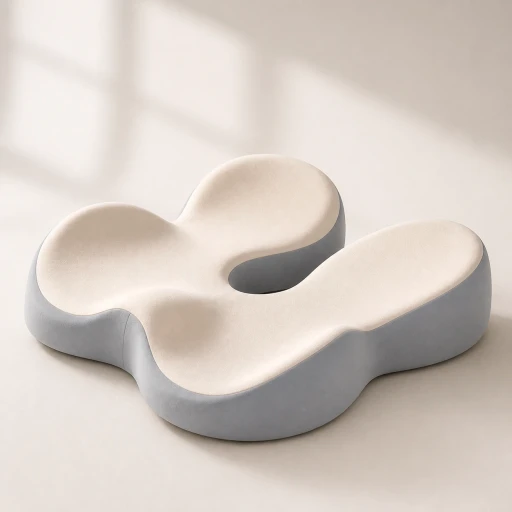
Ergola Memory Foam Seat Cushion
One sculpted memory-foam cushion with a channel open through the rear edge, for the chair you already own.
- 60-day home trial, prepaid return label
- 1-year warranty
- Ships in 1–2 business days
- Card, Apple Pay or Google Pay
Returns: 60 days from delivery, prepaid label; the product price is refunded, the original delivery charge isn't.
Next: the Memory Foam Seat Cushion page, where you pick your cushion and pay on the secure checkout. Nothing is charged before that.
Before you order
Is it a medical product?
No. It's a comfort product, not a medical device: it changes where you make contact with the seat, nothing more. Ongoing or severe pain is a question for a doctor or physical therapist, not for a cushion.
Will it fit my chair?
It's made for broad, stable chair seats, not narrow, small or deeply bucketed ones. Unsure? Email info@ergola.co with your chair model and we'll check before you order.
Does memory foam get warm, or firm up in the cold?
Foam feel can vary with temperature and use. We don't publish test data on it, so the 60-day home trial is the honest way to find out, on your chair and in your room.
Does memory foam flatten?
We don't publish foam density yet, so we won't promise how it holds up over months. Use it for full workdays during the 60 days: that shows you whether it bottoms out early. It can't show you month nine. The 1-year warranty covers defects in materials and workmanship, not ordinary wear.
What if it doesn't suit me?
You have 60 days from delivery. Contact us before you send it back and we'll send a prepaid label within 1 business day. Send it back in its original condition; normal-use wear is fine. Once it's back and checked, the product price is refunded in 3–5 business days, but not the original delivery charge.
When will it arrive?
US orders ship free and usually arrive 5–7 business days after dispatch.
Can I use it in the car?
No. It isn't designed for car seats, which are usually narrow or bucketed.
